Our story
AsiaHotelier was created to bring the industry closer together: one place to discover what is happening across hospitality, understand the people and ideas shaping the industry, and stay connected to the opportunities ahead.
Starting in Vietnam and growing across Asia, our goal is to build more than a news publication. We want to create an information hub for the hospitality community, one that celebrates the people behind the industry, shares knowledge, highlights great hotels and businesses, and helps the industry learn, connect and grow.
Because a stronger hospitality industry starts with better information, stronger connections and a community that shares what it knows.
Mission
To give Asia's hotel decision-makers clear, sourced intelligence they can act on.
- We explain what each development means for owners, operators, revenue teams, developers and hotel talent, as well as what happened.
- We show the data behind every claim, with the source one click away.
- We keep it short enough to understand in a minute and solid enough to take into a meeting.
Vision
To be the hotel publication Asia's industry opens first and trusts most, starting with Vietnam.
- Vietnam first, covered in depth, then the markets our readers invest in, operate in and compete with across Asia.
- The place hotel leaders come to check the numbers before they make a decision.
- A publication that earns trust through its method: sources shown, opinion labelled, corrections made in the open.
How every story works
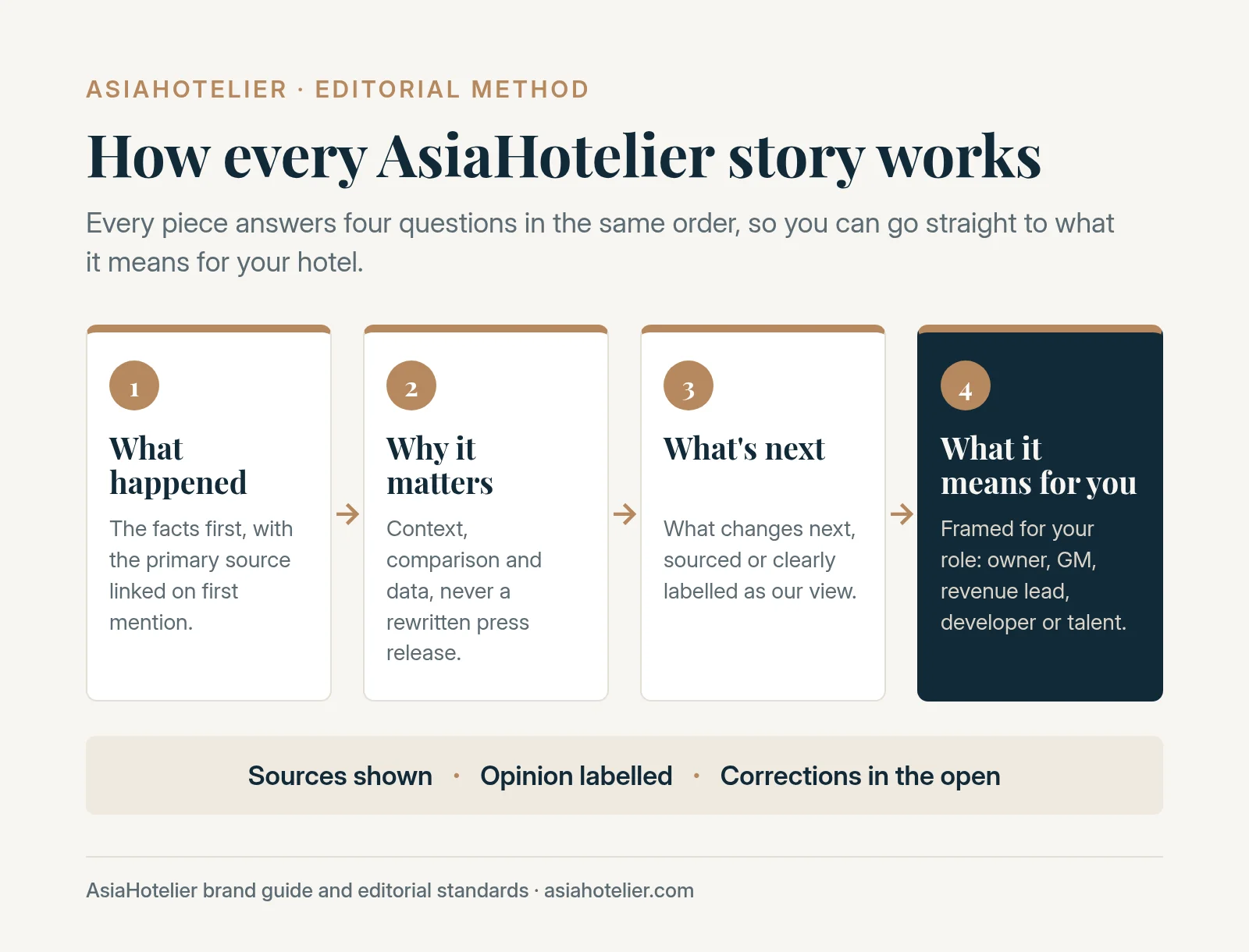
Every story answers the same four questions in the same order, so you can go straight to what it means for your hotel.
What we stand for
- Sources you can check. Every figure links to its primary source on first mention. When we rely on a secondary source, we say so. When a number can't be sourced, we leave it out.
- Analysis, not announcements. A press release becomes a story only when we can add context, comparison, data or consequence. Each piece ends with what it means for you.
- Nothing invented. No made-up figures, people or quotes. A company's claims are reported as the company's claims.
- Opinion and forecasts labelled. Reporting and analysis are kept apart. A forecast is either sourced or clearly labelled as our view.
- Corrections in the open. We fix errors quickly and note material corrections on the story with the date.
- Independence. Commercial relationships never influence our editorial coverage.
Founders

Barney Boken
Co-founder, Strategy and Business Development
Leads AsiaHotelier's market strategy, partnerships and commercial growth.
LinkedIn
Eimantas Kazenas
Co-founder, Technology, Product and Marketing
Leads AsiaHotelier's platform, data and charts, and how our journalism reaches readers.
LinkedInCompany
AsiaHotelier
No. 31 Le Duan Street, Saigon Ward
Ho Chi Minh City, Vietnam
info@asiahotelier.com
How we report
Stories name the companies, hotels and people they are about. A figure is published with its source. If a number cannot be sourced, it is left out.
News is reporting. Insights are analysis. Awards explain the criteria used to judge them. Jobs are listings from the hiring company. Asia Hotelier is not the employer.
Profiles are written from the person's role and the work they are known for. A person is not named in a story until a profile exists for them.
Corrections
If a fact is wrong, write to the newsroom with the story link and the correction. Material corrections are noted on the story. Opinion and analysis are distinguished from reported fact by the section they sit in.
Who it is for
- Hotel general managers and executive teams
- Owners, asset managers and developers
- Investors following the regional pipeline
- Suppliers selling into hospitality