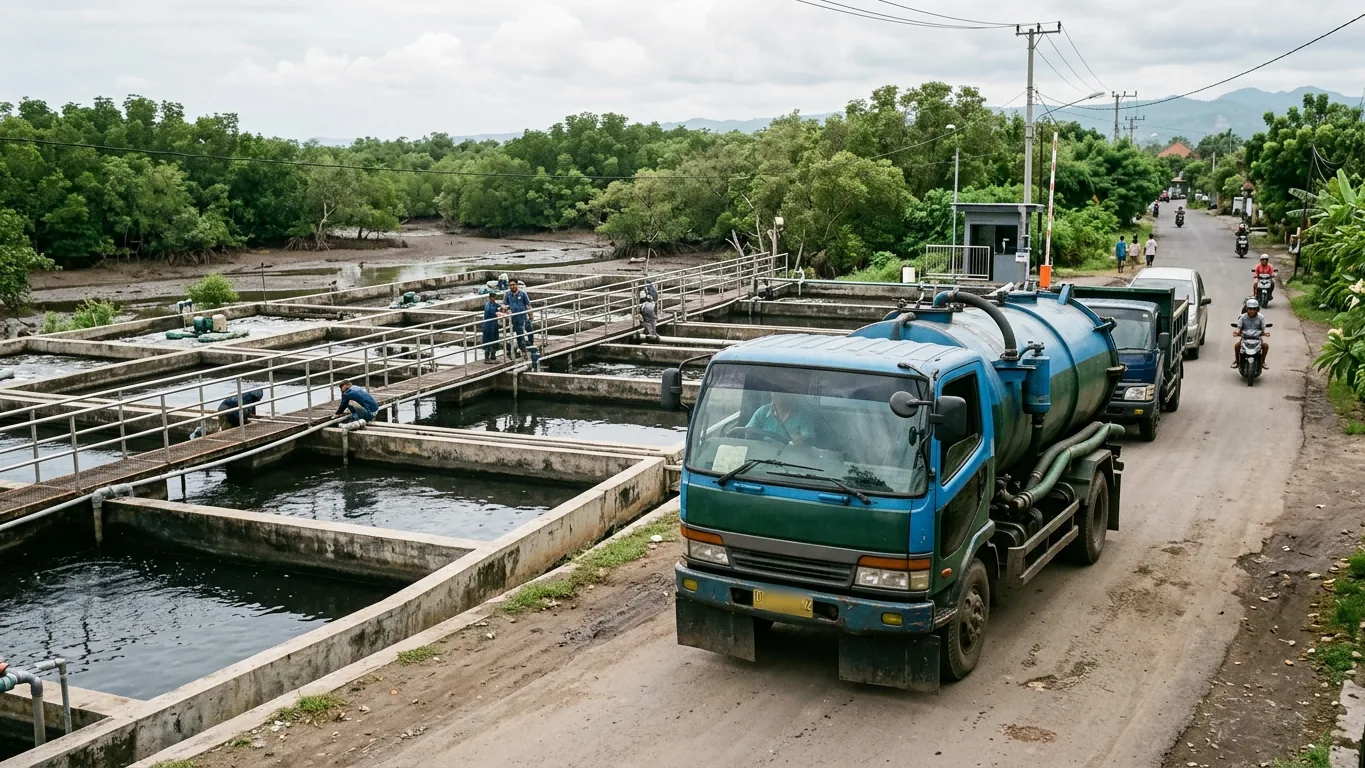
Bali’s environmental debate has mostly been about rubbish. Its next problem is sewage. At a hearing in the provincial parliament on 6 November, officials and septic-tank haulers set out the numbers for IPLT Suwung, the septage treatment plant that serves Denpasar, Badung and much of the south. Trucks queue, the plant can treat only part of what arrives, and its discharge does not meet the standard. Hotels and restaurants sit at the centre of the problem, and lawmakers say they will be at the centre of the fix.
Key facts
| Item | Figure | Who says so |
|---|---|---|
| Trucks received per day | About 130, up from 70 to 80 before a June 2025 upgrade | Bali public works department |
| Trucks needed per day | 210 to 250 | Bali septic haulers’ association |
| Capacity the haulers want | About 400 trucks a day | Haulers’ association |
| Installed treatment capacity | 400 cubic metres a day | Plant operator (UPTD PAL) |
| Temporary holding capacity | About 1,000 cubic metres | Plant operator |
| Share of kitchen waste | More than 60% | Plant operator |
| BOD of treated water | 500 to 1,000 ppm, against a 30 ppm standard | Plant operator |
| Opening hours | 08:00 to 14:00 | Haulers’ association |
What was said
The plant opened in 2016 with an installed capacity of 400 cubic metres a day, the head of the provincial wastewater unit told the hearing. It was designed for household waste. In practice more than 60% of what arrives comes from kitchens, mainly restaurants, and is heavy in fat. The organic load reaching the plant is 25,000 to 35,000 ppm. The water that comes out still has a biochemical oxygen demand of 500 to 1,000 ppm, while the standard is now 30 ppm. The operator says it recirculates that water rather than releasing it next to the mangroves.
A belt filter press, used to dewater sludge, has not worked since 2017. The operator has turned its sludge drying beds into extra holding tanks. That lets it accept about 1,000 cubic metres a day, but the treatment process is still capped at 400.
The head of the septic haulers’ association said demand is 210 to 250 trucks a day against a quota of 130, so his members hold waste in extra trucks overnight. He estimated that close to half the waste his association handles comes from Badung, mostly hotels and restaurants. He also said some loads end up on vacant land when trucks cannot get in. The chair of Commission III, I Nyoman Suyasa, said the committee would consider upgrading the governor’s regulation on wastewater to a regional bylaw, and that large hotels and restaurants should have their own treatment systems, according to Antara’s report of the hearing.
The capacity figures given at the hearing did not all agree. Suyasa cited a treatment figure of 100 to 150 cubic metres a day and said it needed checking. We report each figure with its source.
Our read
This is a hotel and restaurant problem before it is a public works problem. The plant is choking on fat from commercial kitchens, not on household waste. Any rule that follows will look first at large commercial producers in Badung.
Two kinds of obligation are likely. First, grease traps and on-site pre-treatment, so that kitchen waste does not reach the trucks in its current state. Second, on-site wastewater treatment for larger hotels, as Suyasa suggested. Some resorts already treat their own wastewater; Hanging Gardens of Bali, for example, says it runs a natural sewage treatment facility. Older mid-size hotels and villa complexes that rely on septic tanks and trucks are the most exposed.
There is also a reputational risk. Illegal dumping near tourist areas is the kind of story that travels fast. Bali’s government has already shown it will tie hotel permits to compliance, as with its local-products rule. Wastewater could follow the same path.
What it means for you
1. Owners
Find out how your property’s wastewater leaves the site: sewer, on-site treatment or trucks. If it is trucks, budget for pre-treatment or a small treatment plant before a bylaw makes it mandatory.
2. Engineering teams
Service and size grease traps properly, and keep records. Fat is the main reason the public plant fails. A regulator will ask for proof that your kitchens are not adding to it.
3. Developers
Design new hotels and villa projects with on-site treatment and room for sludge handling. Retrofitting later costs more.
4. F&B operators
Restaurants inside hotels are part of the same load. Check what your outside caterers and tenants send down the drain.
FAQ
What is IPLT Suwung?
The septage treatment plant near Denpasar that receives septic-tank waste from much of south Bali, including Badung.
How many trucks can it take?
About 130 a day, according to the provincial public works department. Haulers say demand is 210 to 250 trucks a day.
Why is it struggling?
More than 60% of the waste is fatty kitchen waste, a key machine has been broken since 2017, and its treated water does not yet meet the 30 ppm BOD standard.
Will hotels face new rules?
Possibly. The chair of the Bali parliament’s Commission III says it will consider turning the governor’s wastewater regulation into a bylaw, and that large hotels and restaurants should treat their own waste.
Which hotels are most exposed?
Older hotels and villa complexes that rely on septic tanks and trucks rather than on-site treatment or the sewer network.