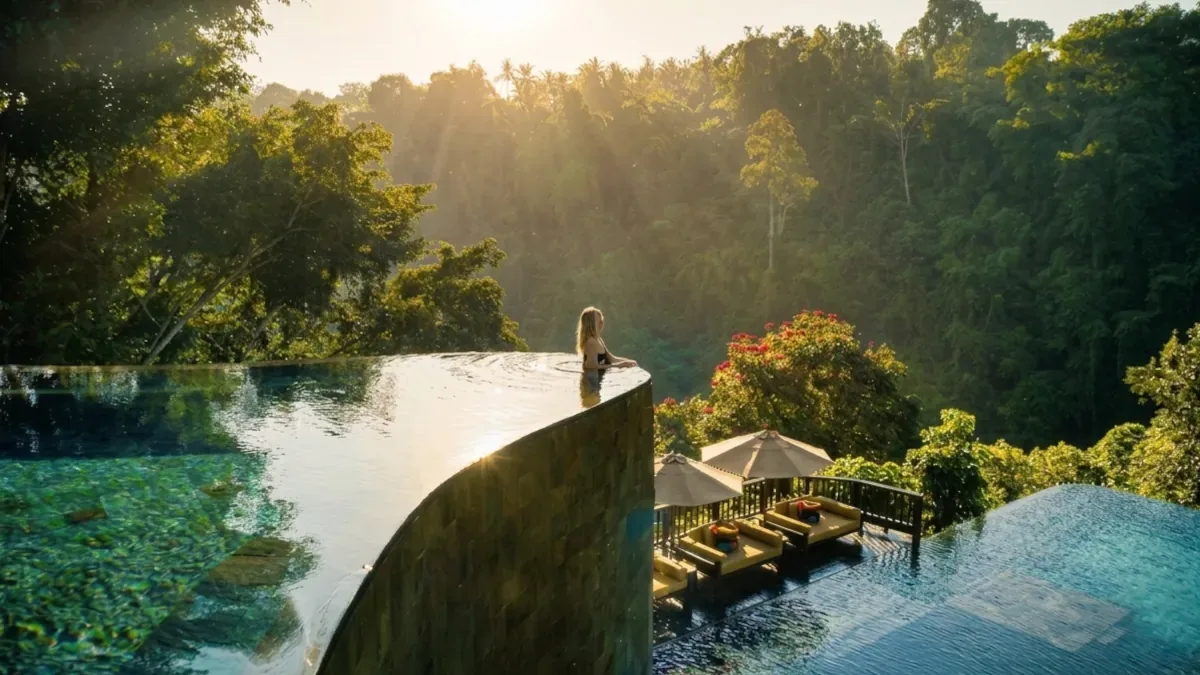
Hanging Gardens of Bali is a 39-villa resort in Buahan village, Payangan, on the hills above the Ayung River north of Ubud. Its two-tier infinity pool over the jungle is, in the resort’s words, one of the most photographed pools in the world. It opened in 2005, spent its early years under Orient-Express management and has been independent since 2013. That makes it one of the few Bali luxury resorts that competes on rate without a global brand.
Key facts
| Item | Detail |
|---|---|
| Location | Desa Buahan, Payangan, Gianyar, Bali |
| Keys | 39 villas and suites (resort); 38 in 2013; 44 in one property database |
| Opened | 2005 (built 2003 to 2005) |
| Owner | Founder Nir Peretz (described as owner); legal entity not verified |
| Operator | Independent, trading as Hanging Gardens of Bali through PT Sanjiwani Bali Indonesia |
| Former manager | Orient-Express Hotels, until November 2013 |
| Recent work | Three-year redesign by BLINK Design Group; The Hidden Palace relaunched as a five-bedroom villa |
Who owns Hanging Gardens of Bali
Nir Peretz, a long-time foreign resident of Indonesia with a background in building materials and property, is described as the developer and owner of Hanging Gardens of Bali and of Nandini Jungle Resort. That description comes from his profile with the Seven Stars Luxury Hospitality and Lifestyle Awards, which inducted him into its “Pantheon”. He also founded Hanging Gardens International, a small group that has added Nandini Jungle Resort, Elevate Bali by Hanging Gardens in Munduk and Essence of Java by Hanging Gardens.
When the resort left Orient-Express in November 2013, the owner was named as PT Buahan. Today the website is operated by PT Sanjiwani Bali Indonesia, “trading as Hanging Gardens of Bali”. A property database names PT Seven Stars Hospitality as the developer.
Reported: the founder as owner, from his awards profile. Verified: independent operation since 2013 and the trading company named on the website. Not verified: which company holds the land and building today, and how PT Buahan, PT Sanjiwani Bali Indonesia and PT Seven Stars Hospitality relate to each other.
The product
The resort is built down a steep valley side, with villas linked by paths and a funicular. Every villa has a heated infinity pool. The signature twin-tier pool sits above the forest canopy. The resort says more than 4,000 Balinese craftspeople worked on it.
A three-year redesign led by Clint Nagata of BLINK Design Group refreshed the interiors without changing the architecture. The resort has also reopened The Hidden Palace, a 2,000 sq m five-bedroom residence on a 5,000 sq m estate, as a standalone villa sold with butler, chef and transport. It has its own 360-degree infinity pool.
The resort promotes awards heavily, including Seven Stars titles. Note that the same awards body lists its owner in its Pantheon. Guest-review scores and repeat rates are a better test of its standing.
How it competes
| Hanging Gardens of Bali | Padma Resort Ubud | Four Seasons Sayan | Capella Ubud | |
|---|---|---|---|---|
| Keys | 39 | 149 | 60 | 23 |
| Owner | Founder (Nir Peretz) | Padma Hotels (Djarum-linked, reported) | Hotel Properties Limited | Private Indonesian owner |
| Operator | Independent | Padma Hotels | Four Seasons | Capella |
| Area | Payangan | Payangan | Sayan, Ayung valley | Keliki |
Its nearest neighbour is Padma Resort Ubud, also in Payangan and almost four times larger. At the top of the market it competes with branded luxury such as Four Seasons Sayan and Capella Ubud, and with central Ubud newcomers such as Alaya Resort Ubud.
Our view: an independent resort without a loyalty programme lives on its image, direct bookings and luxury travel advisers. Hanging Gardens has one image the whole market recognises, its pool. Selling The Hidden Palace on its own is a sensible way to earn more from the same land. The risk is distribution cost. Without a brand’s direct channels, it depends more on online travel agencies and adviser commissions.
What it means for you
1. Owners of single luxury assets
Leaving a brand can work if the asset has a signature feature and a clear story. Budget for the sales, marketing and technology the brand used to supply.
2. Investors
Founder-owned resorts often have unclear holding structures. Map the land rights, the operating company and the brand rights before you value one.
3. Operators
Small inland resorts earn their margin from rate, not volume. Large villas sold as a single booking, like The Hidden Palace, raise the average without adding keys.
4. Ubud revenue managers
Bali’s star-rated hotels averaged 66.42% occupancy in September 2026. Inland luxury resorts should benchmark rate against the brands, not occupancy against the beach.
FAQ
Who owns Hanging Gardens of Bali?
Its founder, Nir Peretz, is described as its developer and owner. The company that holds the property today has not been confirmed publicly.
Who operates Hanging Gardens of Bali?
It is run independently, through PT Sanjiwani Bali Indonesia. Orient-Express Hotels managed it until 2013.
How many villas does Hanging Gardens of Bali have?
39 private villas and suites, according to the resort. The five-bedroom Hidden Palace is sold separately, and the resort does not say whether it is part of the 39.
Where is Hanging Gardens of Bali?
In Buahan village, Payangan, in Gianyar regency, north of Ubud.
When did Hanging Gardens of Bali open?
In 2005, after construction from 2003.