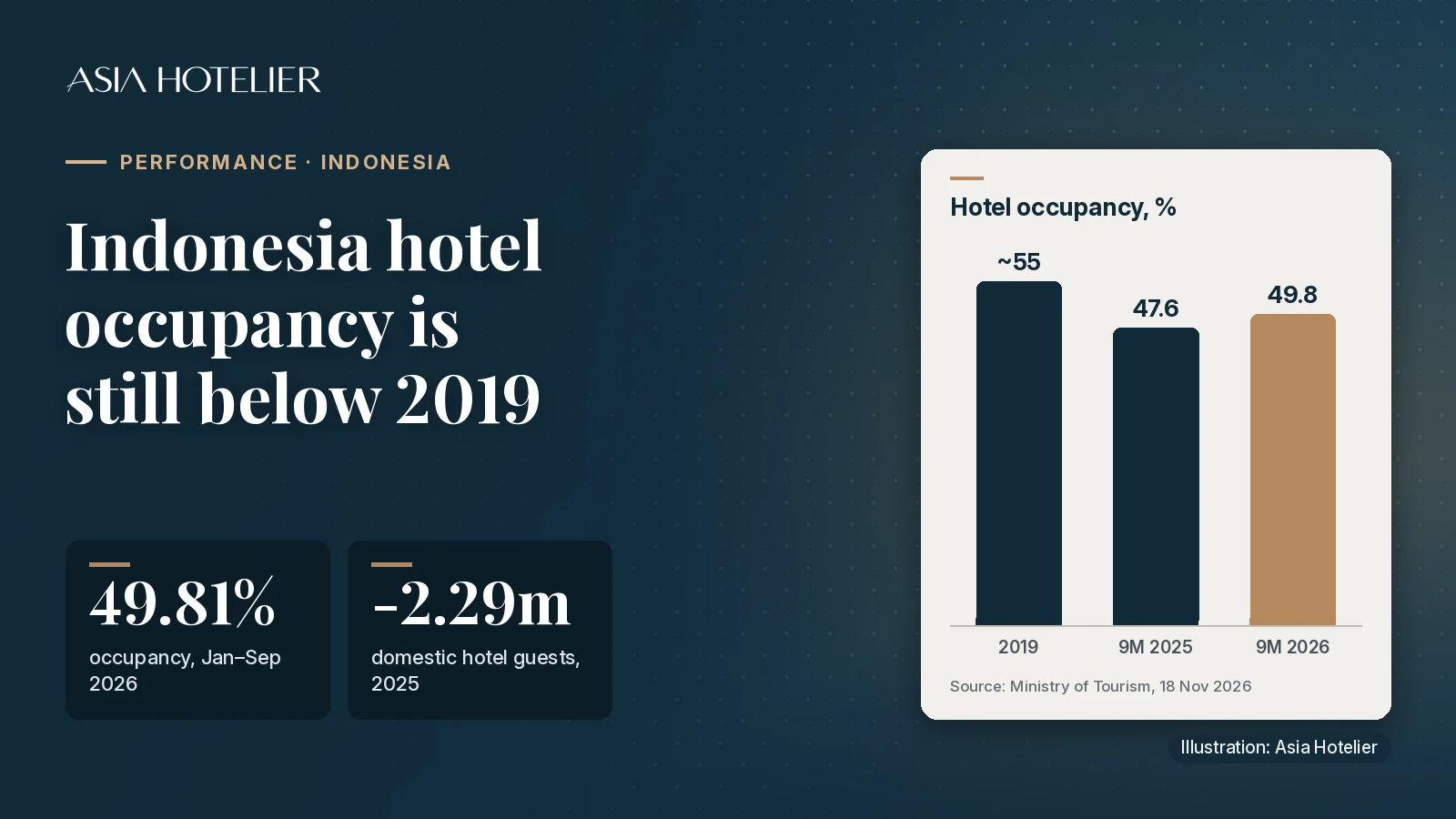
Indonesia hotel occupancy reached 49.81% in the first nine months of 2026, Tourism Minister Widiyanti Putri Wardhana told the Indonesia Hotel Innovation Summit in Jakarta on 18 November. That is 2.23 points better than a year earlier but still short of the almost 55% Indonesian hotels achieved in 2019. Her diagnosis matters more than the number: the gap is domestic, and it is structural.
Key facts
| Item | Detail |
|---|---|
| National occupancy, Jan-Sep 2026 | 49.81% |
| Change on a year earlier | +2.23 points |
| Same period 2025 (our calculation) | About 47.6% |
| 2019 level | Almost 55% |
| Foreign hotel guests | 10.02 million (2024) to 11.15 million (2025) |
| Domestic hotel guests | 81.47 million (2024) to 79.18 million (2025) |
| Growth in hotel numbers | 4.9%, concentrated in Java and Bali |
| Jakarta star-rated occupancy, August 2026 | 55.88% |
| Jakarta non-star occupancy, August 2026 | 41.83% |
The three reasons
The minister named three causes for occupancy falling from 2024 to 2025 and not yet recovering, Tirto reported:
- Fewer domestic guests. Foreign hotel guests rose to 11.15 million in 2025, but domestic hotel guests fell to 79.18 million. Because the domestic market is about seven times larger, the fall outweighs the gain.
- Supply in the wrong places. Hotel numbers grew 4.9%, but mostly in Java and Bali, where competition is already tight.
- Villas and alternative stays. Online travel agents have made it easy for travellers to book villas and other non-hotel stays.
| Guest flow, 2024 to 2025 | Change |
|---|---|
| Foreign hotel guests | +1.13 million (our calculation) |
| Domestic hotel guests | -2.29 million (our calculation) |
Takeaway: the domestic loss was about twice the foreign gain. Foreign demand is growing, but at this scale it cannot carry national occupancy back to 2019 on its own.
Jakarta does better
Jakarta is running above the national average. Its star-rated hotels reached 55.88% occupancy in August 2026 and non-star hotels 41.83%, the city tourism office said, with concerts, festivals, exhibitions and sports events driving demand. The capital received 1.04 million foreign visits in January to June 2026.
Our view: events are now a real demand driver for city hotels in Indonesia. Hotels that sell packages around big concerts and exhibitions are filling rooms that the domestic leisure market is no longer filling.
The villa problem is a Bali problem first
The shift to villas hits hardest where villa supply is largest. Our report on Bali’s September occupancy found the same pattern on the island: foreign arrivals up, the gap domestic. For the luxury end, the pipeline keeps growing, as our IHG Indonesia pipeline report shows, and resorts in Java such as Amanjiwo sell a different product from the villa market.
What it means for you
1. Owners of mid-scale hotels in Java and Bali
Your competition is not only other hotels but private villas on the same booking sites. Compete on what villas lack: service, food, meeting space and loyalty.
2. Operators
The domestic guest is the swing factor. Weekday corporate, government and MICE demand, and weekend packages for families, matter more than another international campaign.
3. Investors
National occupancy below 50% is a warning for new supply in Java and Bali. Look for locations with event demand or limited villa supply.
4. Policymakers and associations
Regulating and taxing villas on the same terms as hotels is the obvious ask from hotel owners. Better data on non-hotel stays would show the real size of the market.
FAQ
What is Indonesia’s hotel occupancy in 2026?
49.81% in January to September 2026, according to the Tourism Minister, up 2.23 points on a year earlier.
Has Indonesian hotel occupancy recovered to 2019?
No. It was almost 55% in 2019.
Why is occupancy still low?
The minister cited fewer domestic hotel guests, hotel growth concentrated in Java and Bali, and travellers choosing villas booked online.
How many domestic hotel guests did Indonesia lose?
Domestic hotel guests fell from 81.47 million in 2024 to 79.18 million in 2025, a drop of about 2.29 million on our calculation.
Which city is doing better?
Jakarta. Its star-rated hotels ran at 55.88% occupancy in August 2026, helped by concerts, festivals and exhibitions.