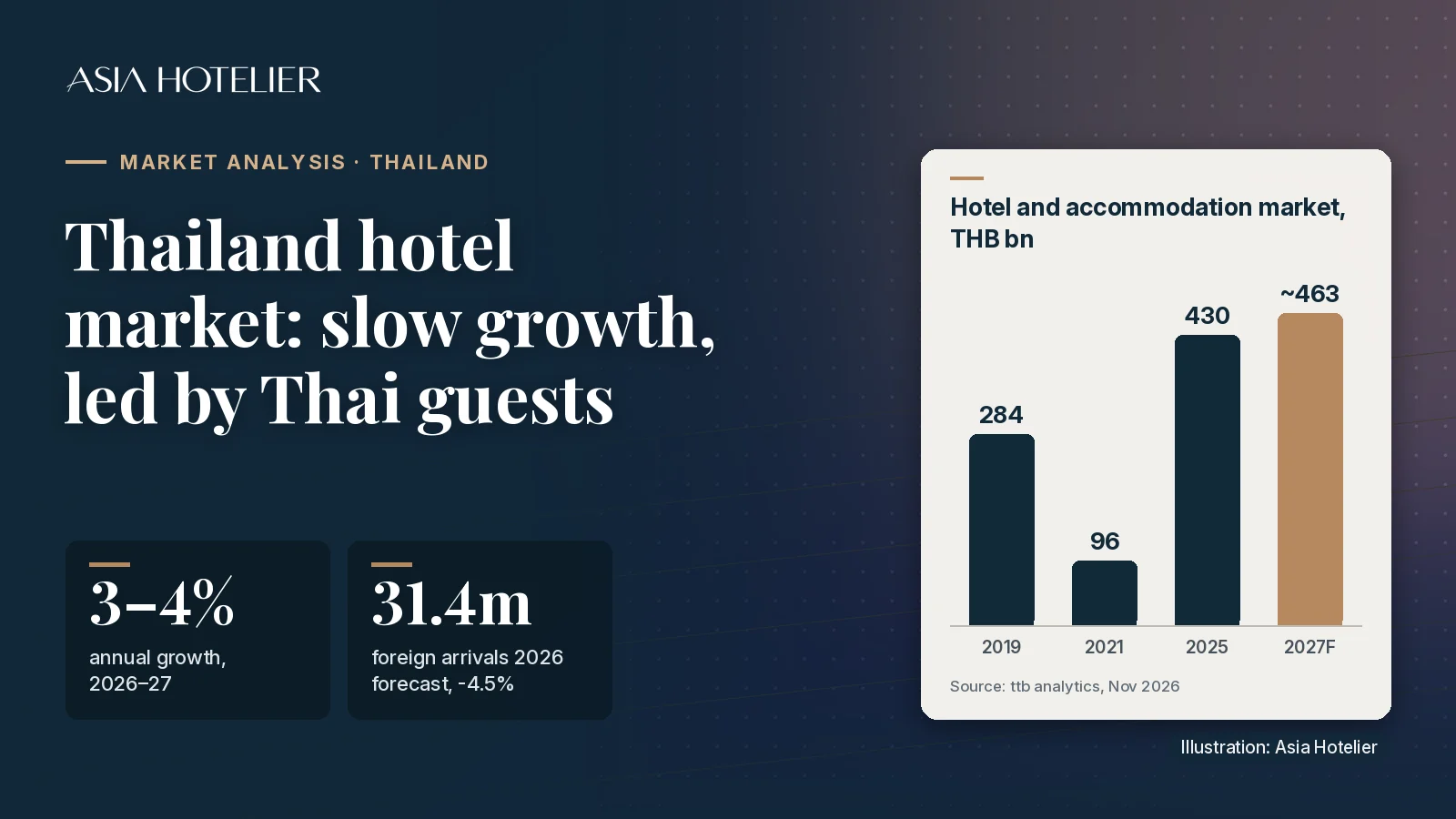
Thailand’s hotel market will keep growing into 2027, but slowly and on the back of Thai travellers rather than foreigners. That is the core of a new outlook from ttb analytics, which sees hotel and accommodation revenue rising about 3–4% a year to roughly THB463bn in 2027. For owners and operators, the more useful message is where the growth will and will not land.
Key facts
| Item | Detail |
|---|---|
| Source | ttb analytics (TMBThanachart Bank), November 2026 |
| Market value 2025 | About THB430bn |
| Forecast 2026 | About THB450bn |
| Forecast 2027 | About THB463bn |
| Annual growth | About 3–4% |
| Foreign arrivals 2025 | 32.9 million (-7.2%) |
| Foreign arrivals, first 10 months of 2026 | 25.5 million (-4.6%) |
| Foreign arrivals forecast 2026 | About 31.4 million (-4.5%) |
| Thai domestic trips, first 10 months of 2026 | 210.5 million (+2.1%) |
| Thai domestic tourism revenue, same period | THB0.89tn (+2.9%) |
From collapse to a slow climb
| Year | Hotel and accommodation market (THB bn) |
|---|---|
| 2019 | 284 |
| 2021 | 96 |
| 2025 | 430 |
| 2026 (forecast) | About 450 |
| 2027 (forecast) | About 463 |
Takeaway: the market is already about half as big again as in 2019, by ttb’s measure, and passed its pre-Covid peak in 2023. The next two years add only about THB33bn on top of 2025, so the rebound phase is over.
The two-speed market
In 2025 foreign arrivals fell 7.2% to 32.9 million while Thai trips rose 3.3% to 279.3 million, and total tourism revenue held at about THB2.9tn (-0.7%). Hotels that rely on foreign guests in the main cities took the hit: occupancy fell 2.3 points in Bangkok and 2.2 points in Phuket. Secondary cities that rely on Thai guests went the other way.
The pattern held in 2026. In the first ten months, Sukhothai (+12.0%), Phayao (+9.7%) and Nakhon Si Thammarat (+8.3%) grew visitor numbers fastest. But spending per trip is flat: Thai visitor spend per head rose only 0.8%, held back by living costs and household debt. Foreign spend per head rose 3.1%, which is why hotel revenue is falling less than arrivals.
Our view: Thai guests bring volume to smaller, value-priced hotels in secondary and drive-to markets. Foreign guests still bring the rate. A hotel’s exposure to each now matters more than its location alone.
The Vietnam question
ttb singles out Vietnam as Thailand’s most direct competitor. Vietnam welcomed 19.5 million foreign visitors in the first ten months of 2026, up 13.8% and more than 30% above its pre-Covid level. Thailand is at about 83% of its 2019 level. ttb points out that Vietnam is growing from the same source markets as Thailand.
ttb blames the slower foreign recovery partly on higher and more volatile airfares since tensions in the Middle East from early 2026, which hit long-haul and some Asian markets. We have covered the effects on Thai hotels in Thailand’s high season favouring lower-star hotels and Thailand hotel closures in 2026.
What supports 2027
- Thai Tiew Thai Plus 2027: a state room subsidy that favours secondary cities, expected to start in April 2027 to lift low-season stays.
- Group tour scheme: Amazing Thailand group travel support, already running, lowers costs for overnight group trips between provinces.
- MICE and events: Thailand hosting the IMF–World Bank Group annual meetings in 2026 and the coming Tomorrowland Thailand festival. These concentrate in the main cities and favour large hotels with many rooms.
What ttb tells hotels to do
| Strategy | Example |
|---|---|
| Event tourism | Build packages around concerts, festivals and conferences |
| Niche positioning | Design for the reason for travel, such as wellness or workation, rather than compete on price |
| Ancillary revenue | Co-working space, cafés, meeting space and long-stay packages |
What it means for you
1. Owners in Bangkok and Phuket
Budget 2027 on flat foreign demand. Protect rate through MICE, events and long-stay segments rather than chase occupancy with discounts.
2. Owners in secondary cities
The subsidy and Thai travel trend favour you, but spend per head is flat. Keep costs lean and sell value rather than upgrades.
3. Operators of large hotels
The IMF–World Bank meetings and big festivals reward hotels with many rooms and full meeting facilities. Lock in group blocks early.
4. Investors comparing Thailand and Vietnam
Thailand is the bigger, more mature market with slow growth; Vietnam is growing faster from the same source markets. Price that difference into yields.
FAQ
How big is Thailand’s hotel market?
ttb analytics puts the hotel and accommodation market at about THB430bn in 2025, rising to about THB450bn in 2026 and THB463bn in 2027.
Is the Thailand hotel market growing in 2027?
Yes, by about 3–4% a year according to ttb analytics, driven mainly by domestic travel and MICE.
How many foreign tourists will Thailand get in 2026?
ttb analytics forecasts about 31.4 million, down 4.5% and the second annual fall in a row.
Which Thai provinces are growing fastest?
In the first ten months of 2026, Sukhothai (+12.0%), Phayao (+9.7%) and Nakhon Si Thammarat (+8.3%) led visitor growth.
What is Thai Tiew Thai Plus 2027?
A government room-cost subsidy for domestic travel that favours secondary cities. ttb expects it to start in April 2027.