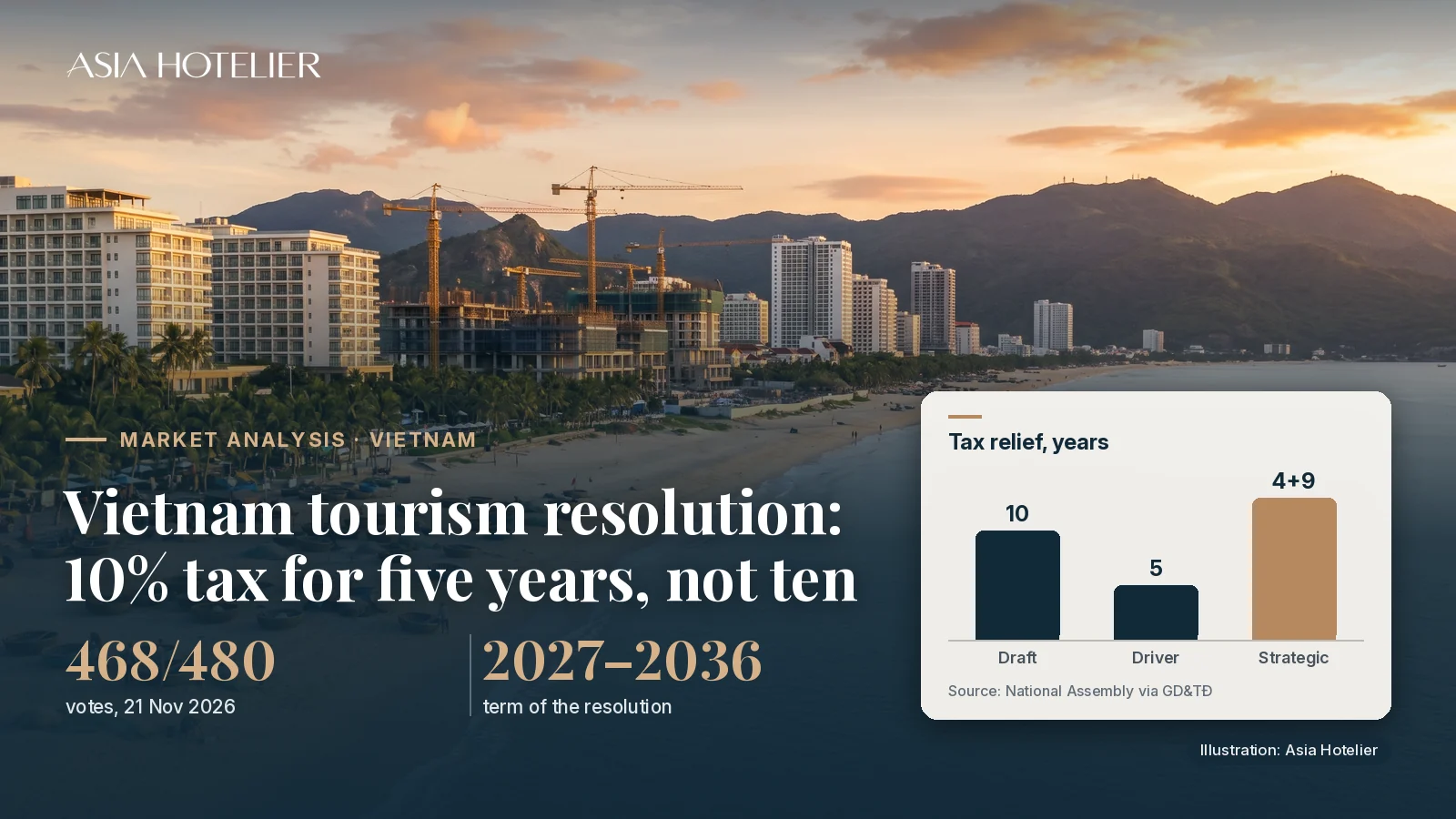
Vietnam’s National Assembly has passed the tourism resolution the industry has been waiting for, and the final text is less generous to most projects than the draft. The Vietnam tourism resolution, adopted on 21 November 2026, cuts the main tax break for large tourism projects from ten years to five and creates a new top tier for “strategic” projects with a much richer package. For hotel owners, the message is the same as in October: the incentives are built for big, low-density destination projects, not for adding rooms to a city plot.
Key facts
| Item | Detail |
|---|---|
| Instrument | National Assembly resolution on special mechanisms and policies for tourism, reported as Resolution 59/2026/QH16 |
| Vote | 468 of 480 deputies in favour, 21 November 2026 |
| Term | 1 January 2027 to 31 December 2036; pilot tax and land policies run for five years |
| Priority areas | Hanoi, Ho Chi Minh City and Da Nang; tourism centres; national tourism areas; community tourism areas |
| Project tiers | Small and medium; high-quality; driver; strategic driver |
| Driver projects | Corporate income tax as low as 10% for five years on tourism income; land-rent exemption or reduction |
| Strategic driver projects | Up to four years tax-free, then 50% off for up to nine years; operating term up to 70 years |
| Land rent for resorts | Up to 30% off for five years on green, water and shared areas of 4-star-plus resorts in qualifying areas with gross density under 25% |
| New business models | Two years tax-free, then 50% off for four years on income from the new model |
| Pilots | 24/7 operation for large entertainment complexes, concert venues and festival streets |
What changed from the draft
In October, the culture and tourism ministry’s draft offered “catalytic” projects a 10% corporate income tax rate for ten years; we covered it in our piece on the draft. The adopted text, as reported by Giáo dục và Thời đại, splits that offer in two.
| Tier | Corporate income tax | Other benefits |
|---|---|---|
| Driver project | Rate as low as 10% for five years | Land-rent exemption or reduction; one-stop handling of investment, land, construction and environment procedures |
| Strategic driver project | Exempt for up to four years, then 50% off for up to nine years | Operating term for tourism components of up to 70 years |
| New business model | Exempt for two years, then 50% off for four years | Applies to income from the new model only |
The government still has to set the thresholds that decide which tier a project falls into, and the exact rates and periods. The resolution also lets the state take incentives back if an investor does not meet its commitments.
Our view: five years at 10%, counted from the first year of taxable income, is worth much less than ten to a resort that takes several years to reach stable profit. The real prize is now the strategic tier, and that will be reserved for a small number of very large projects chosen by the state.
Where existing hotels can benefit
Most operating hotels will not qualify as driver projects. Three parts of the resolution reach them more directly:
- Land rent on green space. Resorts of four stars and above, in a tourism centre or national tourism area, with gross building density below 25%, can get up to 30% off land rent for five years on landscaping, water features and shared areas that are not used for direct business. Low-density beach resorts in places such as Phu Quoc, Nha Trang, Da Nang or Ha Long are the obvious candidates, subject to the conditions.
- Visas and air routes. The resolution backs easier entry and longer stays for high-spending, long-stay, MICE and remote-working visitors, and lets provincial councils pay airlines and tour operators to open or restore routes.
- Local buying. Accommodation businesses with long-term contracts to buy local OCOP products can be considered for provincial support.
What it means for you
1. Developers of large resort projects
Find out early which tier your project can reach. The difference between a driver and a strategic project is now several years of tax, and a 70-year term.
2. Owners of low-density resorts
Measure your gross building density and your green and shared areas now. The 30% land-rent cut is conditional, and the five-year pilot window starts on 1 January 2027.
3. City hotel owners
The tax benefits are unlikely to reach a standard city hotel. The upside is indirect: new routes, easier visas and 24/7 entertainment districts in the big three cities.
4. Investors
Price incentives only once the government decree sets the thresholds, and allow for clawback if commitments slip.
FAQ
When does Vietnam’s tourism resolution take effect?
On 1 January 2027. It runs to 31 December 2036, and its pilot tax and land policies last five years.
What tax break do tourism projects get?
Driver projects can pay corporate income tax as low as 10% for five years on tourism income. Strategic driver projects can be tax-free for up to four years and pay half the tax for up to nine more.
Do existing hotels get a land-rent cut?
Resorts of four stars and above in tourism centres or national tourism areas, with gross building density under 25%, can get up to 30% off land rent for five years on green, water and shared areas, if they meet the conditions.
Who decides which projects qualify?
The government will set the criteria, rates and periods in implementing rules, and can take incentives back if investors do not keep their commitments.
Does the resolution allow 24-hour entertainment?
Yes, as a pilot. Large performance complexes, concert venues, festival streets and integrated entertainment areas can trial 24/7 operation under provincial schemes.