Korean tourists to Vietnam fell by about 5% in the first nine months of 2026, to roughly 3.05 million, even as Koreans took more trips abroad. That makes South Korea the only one of Vietnam’s ten largest markets to shrink, in a year when total international arrivals rose 14.5%. For hotels in Da Nang, Nha Trang and Phu Quoc, where Korea is the core market, this is not a demand collapse. It is a price and product test, and some of the pressure comes from hotel rates.
Key facts
- Korean arrivals, January–September 2026: about 3.05 million, 17.3% of the total, about 95% of the same period last year, according to the National Statistics Office as reported by VnExpress.
- All international arrivals: 17.7 million, up 14.5%. September alone: 1.77 million, down 11.3% on August and up 16.1% on September 2025.
- Second year of decline: Korean arrivals also fell about 5% in 2025, when Vietnam set a record of more than 21 million international visitors.
- Korean outbound travel: more than 19 million trips in January–August, up 2%, according to the Korea Tourism Organization.
- Where it went: in the first half, Japan drew 5.6 million Korean visitors, up 18.6% and close to 40% of all Korean outbound travel. Mainland China drew 1.7 million, up 16%. Nine of the twelve top destinations fell, Vietnam by just over 2% and Thailand by 24%, according to Yanolja Research.
- Accommodation and food services: revenue up 16.7% in January–September, according to the National Statistics Office.
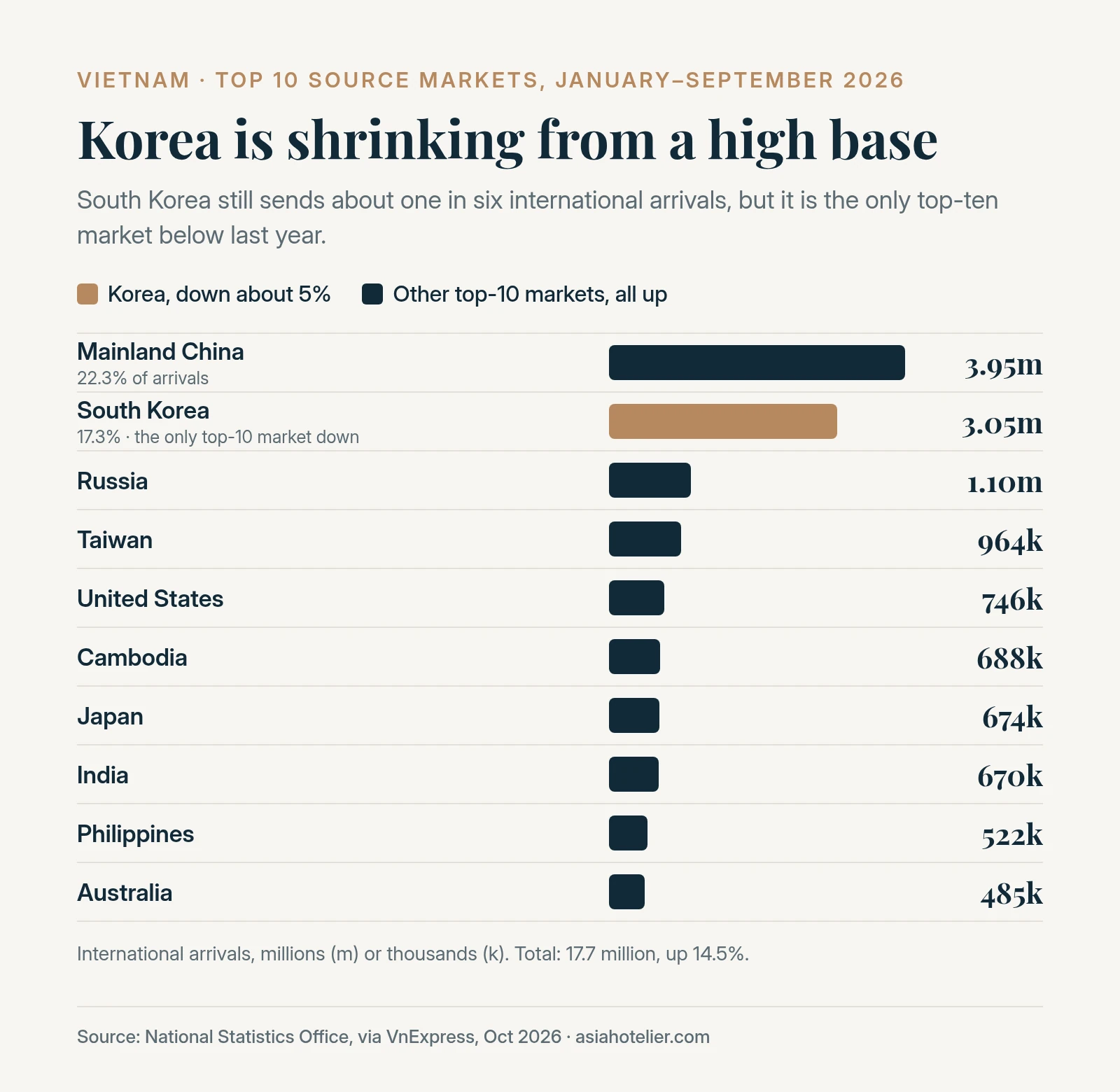
Takeaway: Korea is still Vietnam’s second-largest market by a wide margin, so a small percentage fall in Korean demand weighs more on coastal hotels than strong growth from smaller markets can easily replace.
Why Korean demand is moving
| Factor | What the sources say |
|---|---|
| Hotel prices | Nguyễn Tiến Đạt, chief executive of AZA Travel, told VnExpress that room shortages in Da Nang and Phu Quoc this summer pushed hotel rates up, and that Korean guests are price-sensitive and switch destinations when costs rise. |
| Exchange rate | The won fell to about 1,536 to the US dollar on 3 June, its weakest since 2009, and now trades around 1,350. Korea JoongAng Daily reported Koreans spending more carefully and moving from upscale hotels to Airbnb-style rentals. |
| Competition | Japan benefits from a weak yen, short flights and service quality; China from visa-free entry for Koreans since late 2025 and new direct routes, according to Phạm Hải Quỳnh, head of the Asia Tourism Development Institute. |
| Flight time | Martin Koerner, commercial director of The Anam Group, said a two- to three-hour flight to Japan or China now competes hard with four to six hours to South-East Asia. |
| Air capacity | Korean airlines, mostly low-cost carriers, cut nearly 1,000 flights in April–June as Middle East fuel costs rose, according to Yanolja Research. |
| Destination fatigue | Quỳnh said Da Nang, Nha Trang and Phu Quoc have been promoted in Korea as favourites since about 2023, and repeat guests now see them as familiar. |
| Safety perception | Yanolja Research said coverage of scam compounds in Cambodia drew Vietnam into negative search associations; negative sentiment towards Vietnam peaked at 18%. |
| Package mix | Hanatour said guests are moving from cheap shopping tours to dearer packages without shopping stops. |
What it means for owners and operators
1. The rate premium has a ceiling
The tour operator’s account is the uncomfortable part for hotels: tight summer supply let coastal hotels raise rates, and Korean demand went to Japan, where a weak yen makes good hotels cheap. Our view: for Da Nang and Phu Quoc hotels with a large Korean base, peak-season yield gains in 2026 may have cost repeat demand in 2027. Price Korea as a long-term account, not a peak-week opportunity.
2. Shorter booking windows need faster pricing
Koerner said Korean guests now book weeks ahead rather than months. Hotels that load Korean rates and allotments once a season will be slow. Weekly pace reviews for the Korea segment, faster release of unsold allotments and promotions that can launch in days are now basic revenue management.
3. Sell the upgrade, not the discount
Hanatour’s shift to dearer no-shopping packages and the move to rentals point the same way: Korean travellers will pay for value they can see, and will cut the hotel if they cannot. Families, golf and spa travellers, and the secondary cities Quỳnh names, Busan, Daegu and Gwangju, are where packaged product with a clear inclusion can still win.
4. Diversification is working, but not everywhere
Koerner also said European arrivals are up more than 50%, with strong growth from the US, Australia and India. That helps Hanoi, Ho Chi Minh City and the long-haul resort markets. It helps Nha Trang less: Korea was about 40% of the city’s international visitors in the first half, as our Nha Trang tourism report shows. Owners there should stress-test 2027 budgets for a further Korean fall.
For national demand, rates and occupancy, see our Vietnam hotel market report.
What to watch
- Fourth quarter: a further fall in Korean arrivals in Q4, after the summer rate spike has passed, would confirm a trend rather than a one-season price shock.
- The 25 million target: arrivals so far are about 71% of the government’s 25 million target for 2026. Hitting it needs at least 2.4 million a month in Q4, our calculation, against 1.77 million in September.
- Air capacity and the won: restored low-cost seats from Korea and a stronger won would help quickly. Neither is in hotels’ hands.
- October data: the National Statistics Office publishes October arrivals in early November.
FAQ
How many Korean tourists visited Vietnam in 2026?
About 3.05 million in January–September 2026, according to the National Statistics Office, as reported by VnExpress. That is about 95% of the same period in 2025.
Why are Korean tourists to Vietnam declining?
Sources point to higher hotel rates in Da Nang and Phu Quoc, a weak won, cheaper and closer options in Japan and China, cuts to low-cost flights, familiarity with Vietnam’s beach destinations and some negative safety perceptions.
Is South Korea still Vietnam’s second-largest source market?
Yes. Korea supplied about 17.3% of arrivals in January–September 2026, behind mainland China at 22.3% and well ahead of Russia at 1.1 million.
Where are Korean tourists going instead?
Mostly Japan, which drew 5.6 million Korean visitors in the first half, up 18.6%, and mainland China, up 16%, according to Yanolja Research.
What should hotels do about falling Korean demand?
Price Korea as a long-term account, review pace weekly because booking windows are now weeks, and sell packages with clear inclusions rather than discounts. Hotels in Nha Trang, where Korea is about 40% of international demand, should plan budgets for a further fall.